
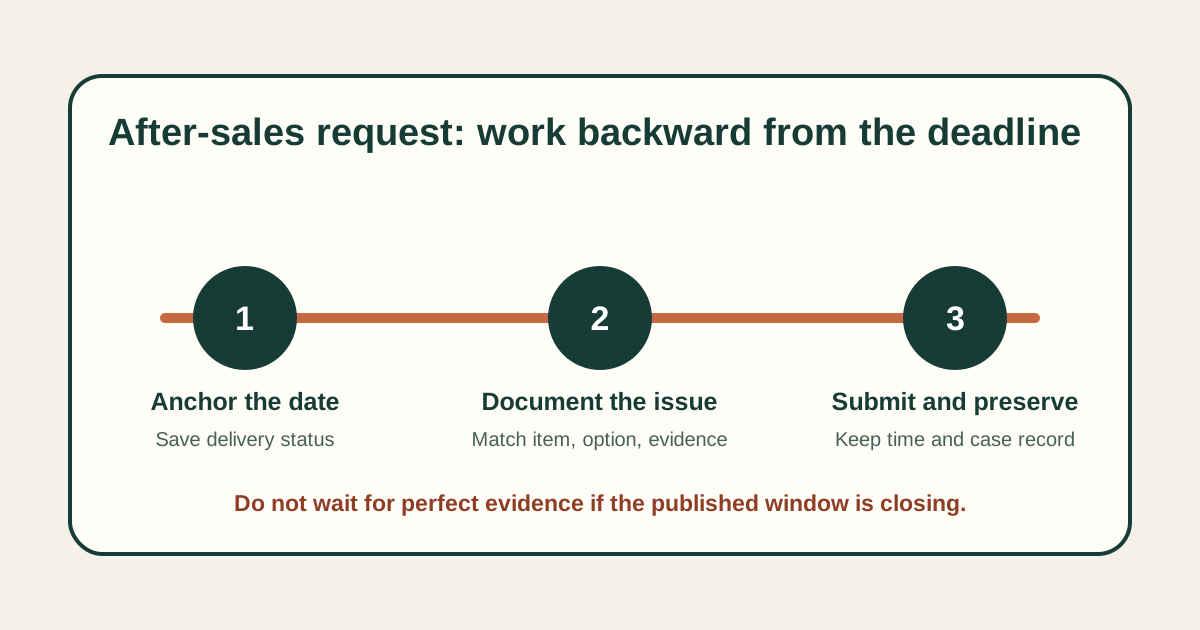
Calculate first, investigate second, submit third
Open the exact Hacoo order as soon as you identify a problem. Save the displayed delivery date, order number, affected item, selected option and current status. Hacoo's Shipping & Delivery page, checked on August 29, 2026, says that after-sales service should be requested within 15 days of delivery and tells users to follow the refund instructions shown for the request. Treat that published period as an outer limit, not as permission to wait until day fifteen.
The practical rule is simple: calculate a conservative deadline from the platform's recorded delivery date, preserve the original evidence, and submit a clear request early. If one detail is still missing, state that it is pending. Do not let a search for perfect photographs or a seller response consume the available window.
Official facts checked August 29, 2026
- Published timing
- Hacoo's shipping page says to request after-sales service within 15 days of delivery.
- Instructions
- The page directs users to follow the refund instructions presented for the request.
- What this does not prove
- The wording does not guarantee eligibility, acceptance, a fixed refund amount or a universal resolution time.
- Safe working rule
- Use the displayed delivery record and submit well before the latest plausible deadline.
Read the published window narrowly
“Within 15 days of delivery” contains two variables: which delivery event starts the count and how the platform counts the days. The checked public wording does not define every edge case, time zone or partial-delivery scenario. Avoid inventing a calculation rule. Use the delivery date shown for the affected shipment, count conservatively, and ask support which date applies when multiple parcels or corrected carrier events exist.
A request window is procedural. It indicates when a user should act; it does not establish that a damaged, wrong, missing or unwanted item qualifies for the same remedy. The evidence and request category still matter. Likewise, “refund instructions” means the current on-screen steps should control. A blog checklist cannot replace options, labels, upload fields or return directions displayed inside the live order flow.
Capture the policy page and order record on the day you prepare the request. Policies and interfaces can change. Your dated copy shows what you relied on without claiming that old wording governs forever.
Keep three dates separate in your notes: the carrier event, the delivery date displayed by Hacoo, and the day you first observed the problem. They may coincide, but they answer different questions. The first helps trace the parcel, the second anchors the published window, and the third explains when inspection occurred. If a status changes after you have saved it, add the new event to the timeline; do not overwrite the earlier record.
Build a deadline record you can defend
- 1Identify the affected shipment.
Match the item to its parcel and tracking reference. Split orders may have different delivery dates.
- 2Save the platform date.
Record the delivery date in the Hacoo order or logistics view, not just the date you opened the parcel.
- 3Save the carrier event.
Keep the carrier's exact delivered wording, time and location as supporting evidence.
- 4Set an early internal target.
Choose a submission date comfortably before the apparent outer limit. This is your planning buffer, not an official rule.
- 5Record uncertainty.
If the platform and carrier dates differ, preserve both and ask which controls rather than silently choosing the later one.
- 6Keep proof of submission.
Save the request time, category, uploaded files, written description and any case reference.
For example, if the Hacoo order displays delivery on August 20 and the carrier shows a late-evening scan on August 19, do not publish a definitive “last day.” Record both dates, plan from the earlier one, and submit promptly. The value of the example is the method, not a universal counting formula.
Prepare an evidence pack that answers four questions
Which order and item?
Include the order reference, exact item title, selected colour, size, quantity and the parcel or tracking number connected to it. Crop a working copy if needed, but retain the original full record privately. Never post an address, telephone number, payment identifier or complete tracking code in a public forum.
What was expected?
Save the product-page details and option selection that were visible when you ordered, if available. Distinguish a stated specification from an impression created by photography. A saved page does not prove quality or authenticity, but it can show the option and information on which the request relies.
What arrived?
Use neutral, observable language: “label states M while the order states L,” “left seam is open for approximately four centimetres,” or “one of two units is present.” Avoid conclusions such as “fake,” “fraud” or “unusable” unless the current request process specifically asks for that classification and you have appropriate evidence.
When was the problem recorded?
Preserve the delivery event, unboxing or first inspection time, photograph timestamps, and submission time. A coherent timeline is more useful than twenty screenshots with no explanation.
Match the evidence to the issue, not to a generic template
| Issue observed | Most useful evidence | Do not claim |
|---|---|---|
| Wrong option | Order option, packaging label and full-item photograph | That colour on a screen proves a calibrated colour value |
| Visible damage | Full item, close-up, scale reference and packaging condition | The exact cause of damage from one image |
| Missing quantity | Ordered quantity, parcel contents and packaging overview | That a split shipment is impossible before checking tracking groups |
| Fit or measurement concern | Seller size information and repeatable garment measurement | That a size label alone proves incorrect fit |
| Delivered parcel absent | Carrier event, delivery proof and local-search timeline | A refund outcome; use the carrier-first process for that scenario |
If the request form limits attachments, lead with identity, the clearest overview, the decisive close-up and the date record. Keep additional originals ready. More files are not automatically stronger evidence; relevance and traceability matter.
Photograph in ordinary light when possible and include one overview before close-ups. A close crop can show a loose seam but may not show which garment, side or option it belongs to. When measurement is relevant, show both endpoints and the complete measuring tool in a second image. State the method rather than presenting one reading as a guaranteed fit result. For quantity concerns, photograph all received contents together and retain the outer packaging label in the private case file.
Write one answerable after-sales request
Use a compact structure: “Order [reference], item [exact item], delivered [displayed date]. I selected [option]. The received item shows [observable discrepancy]. I attached [evidence]. I am submitting within the published after-sales period. Please confirm the current remedy and any next step or return instruction.”
Select the closest available issue category and follow the on-screen refund or return directions. If the interface asks for a particular angle, label or document, supply it without replacing the existing originals. Do not send an item elsewhere, discard packaging or incur postage solely because an unofficial post suggested it. Wait for the case-specific official instruction.
After submission, save a screenshot or export showing the time, description and attachments. If no case reference appears, record the exact route used and check the order history or message area. Follow up with the same facts rather than creating conflicting versions.
Avoid the four deadline mistakes that weaken a request
Waiting for certainty. Submit the known facts before the window closes and identify what remains uncertain. Using the purchase date. The checked wording is tied to delivery, so preserve the delivery record. Combining separate problems. Match each affected item and shipment before describing the issue. Treating submission as approval. A timestamp proves that a request was made, not that a remedy is guaranteed.
Also avoid editing evidence destructively. Keep original files, make separate annotated copies, and explain any markups. Do not reuse photographs from another order, creator or review. That breaks the connection between the request and the delivered item.
Questions about the Hacoo after-sales request window
Is the window definitely fifteen 24-hour periods?+
The checked public page says within 15 days of delivery but does not define every counting edge case. Use the displayed delivery date, act early and ask support when dates conflict.
Does submitting within the window guarantee a refund?+
No. Timing, eligibility, evidence and the current case instructions are separate questions.
What if an order arrived in two parcels?+
Match each affected item to its shipment and preserve each delivery date. Ask which date applies instead of assuming one date controls the whole order.
Should I remove personal details from evidence?+
Keep complete originals for the official channel. Use redacted copies only when sharing more broadly, and never publish addresses, payment data or full tracking numbers.
Continue with the matching internal guide
- Refund instruction checklist — match each live request field to a precise evidence record.
- Delivered-but-missing checklist — follow the carrier-first evidence route for a missing delivered parcel.
- Split-shipment checklist — confirm whether an item belongs to another parcel.
- Wrong-address evidence guide — preserve the entered address and shipment state.
- Shipping planning guide — keep fulfilment, transit, delivery and after-sales timing separate.
- Hacoo Pro FAQ — understand the limits of this independent support resource.
Protect the deadline before perfecting the file.
Anchor the date, document the exact item and discrepancy, then preserve a traceable submission record.